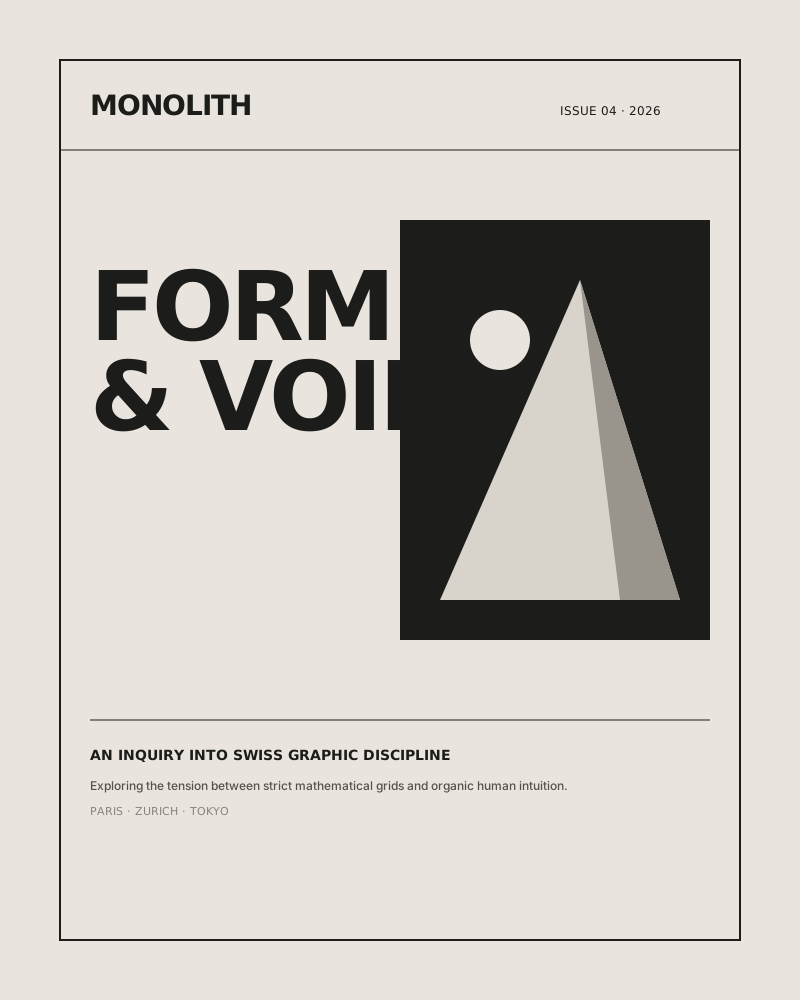
The Architectural Grid as a Canvas
Swiss graphic design has long revered the mathematical grid as the supreme arbiter of spatial organization. From Josef Müller-Brockmann to Armin Hofmann, the column system served not as a prison, but as an architectural liberation.
Yet on the interactive canvas, static alignment is only the first dimension. When user intent meets digital surfaces, physics must bridge the tactile divide.
// Exponential easing function for kinetic letter physics
function springDecay(velocity, stiffness, damping) {
    return (target - current) * stiffness - velocity * damping;
}
Kinetic Restraint
True luxury in interface design lies in what you omit. Micro-interactions should not shout; they should whisper. When a cursor touches typography, the resulting distortion should feel like water displacing beneath an oar — immediate, fluid, and obedient to momentum.
ADVERTISEMENT
Google AdSense



READER ESSAY DISCUSSIONS (0)
Share your architectural perspectives, technical notes, or critique.
No discussions recorded yet.
Be the first to spark the dialogue on this essay.