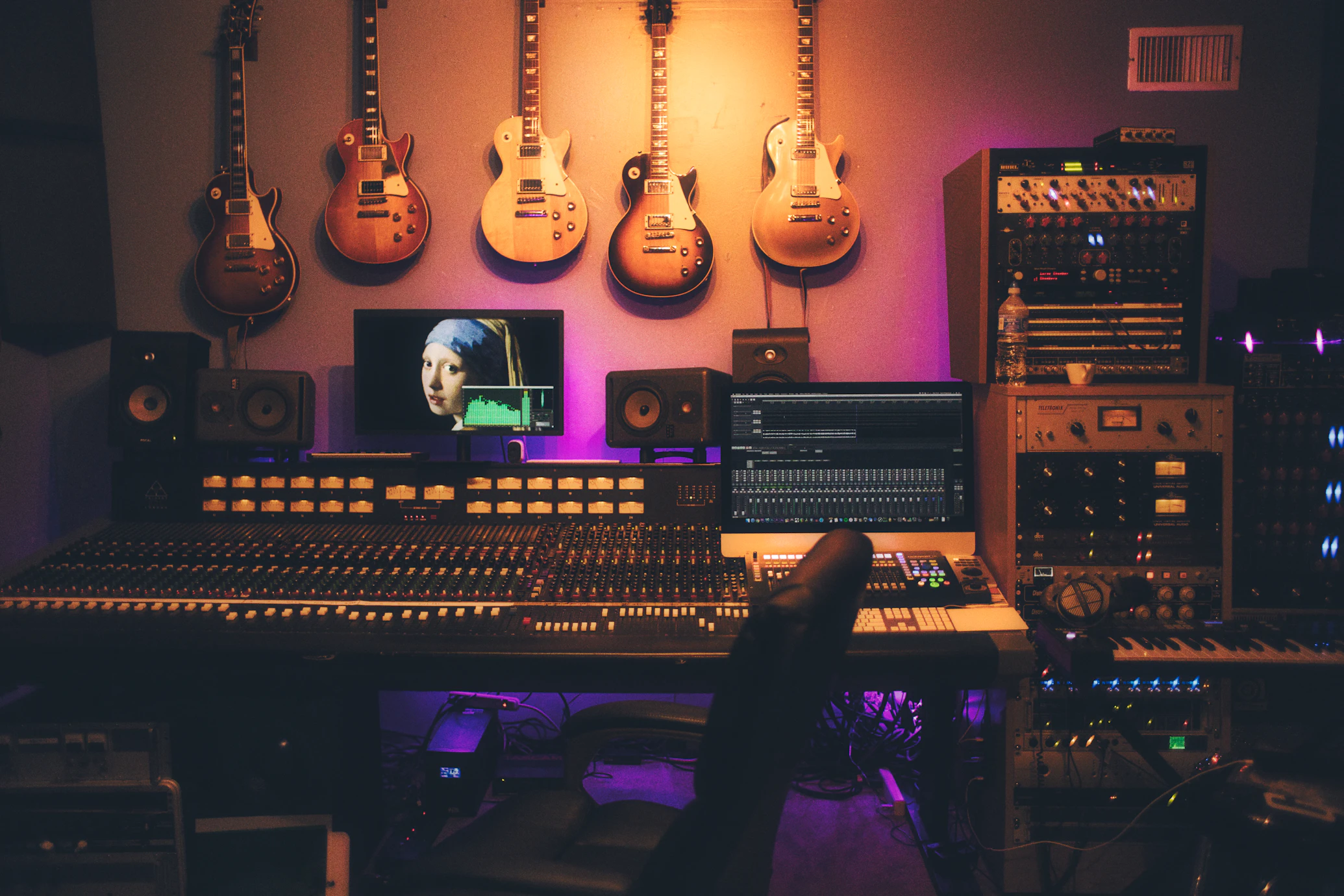
The Audio-Visual Disconnect
We spend weeks optimizing draw calls and baking lightmaps, yet we treat the audio layer as an afterthought—an MP3 slapped onto a trigger. It kills the immersion. When a user pans their camera across a WebGL scene, the visuals scream ‘depth’ while the audio plays flat, stereo-locked noise. It’s an auditory uncanny valley. If you want a user to believe in your architecture, the sound must exist in the same coordinate space as the geometry.
The PannerNode is Not Enough
Standard Web Audio API implementations usually stop at a basic PannerNode. It’s the ‘hello world’ of spatial audio. It gives you a sense of direction, sure, but it ignores the room. Real architecture is defined by boundaries. Sound doesn't just travel from a point; it bounces, absorbs, and decays against materials. If you are building a virtual gallery, the reverb in a concrete corridor should be distinct from the dead-air of a carpeted room. We rarely see this because it requires managing an audio graph that tracks state alongside our scene graph. It is hard work. It is also the only way to make the space feel real.
The ear is a more demanding critic than the eye. You can hide a low-poly mesh in shadow, but you cannot hide a sound that doesn't respect the geometry of the room.
Managing the Audio-Scene Graph Sync
When we built our last interactive installation, we stopped treating audio as a global listener. Instead, we attached instances of AudioContext directly to our scene’s entities. Every light source or mechanical object became an emitter. The performance overhead? Minimal, provided you aren't spawning a hundred oscillators. The real issue is state management. You need a centralized manager to handle:
- Occlusion: Raycasting from the listener to the emitter to determine if a wall is in the way.
- Material-based Reverb: Passing current scene metadata to your convolution reverb nodes.
- Distance Attenuation: Using linear or exponential rolloff models that match your camera’s field of view.
// A quick prototype for an occluded audio emitter
function updateAudioOcclusion(emitter, listener) {
  const raycaster = new THREE.Raycaster();
  raycaster.set(listener.position, emitter.position.clone().sub(listener.position).normalize());
  const intersects = raycaster.intersectObjects(scene.children);
  if (intersects.length > 0 && intersects[0].distance < listener.distanceTo(emitter)) {
    gainNode.gain.setTargetAtTime(0.2, context.currentTime, 0.1); // Muffle the sound
  } else {
    gainNode.gain.setTargetAtTime(1.0, context.currentTime, 0.1);
  }
}
Beyond the Browser's Limits
The Web Audio API is powerful, but it’s an abstraction. Browsers are notoriously inconsistent with sample rate conversion and buffer latency. If you are pushing high-fidelity soundscapes, stop relying on new Audio(). Use AudioWorklet to keep your processing off the main thread. When your main thread hitches during a texture upload or a heavy geometry calculation, the audio shouldn't stutter. A stuttering soundscape is the fastest way to break a user's suspension of disbelief.
The Architecture of Silence
We often obsess over what we add, but the best spaces are defined by what we take away. In an interactive environment, silence is a tool. Use it to draw attention to specific architectural features. If a user walks into a massive, cavernous hall, don't fill it with ambient drones. Let the natural reverb—the 'tail' of the sound—do the heavy lifting. Create a silence that feels heavy. It’s a design choice that signals respect for the scale of the environment you’ve built.
Stop thinking about sound as a soundtrack. Think of it as a structural material. It has mass. It reflects. It occupies volume. When you start treating your audio graph with the same architectural rigor as your vertex shaders, the entire experience changes. The geometry stops being a flat image on a screen and starts being a place you can actually inhabit.



READER ESSAY DISCUSSIONS (0)
Share your architectural perspectives, technical notes, or critique.
No discussions recorded yet.
Be the first to spark the dialogue on this essay.